
Enroll Now

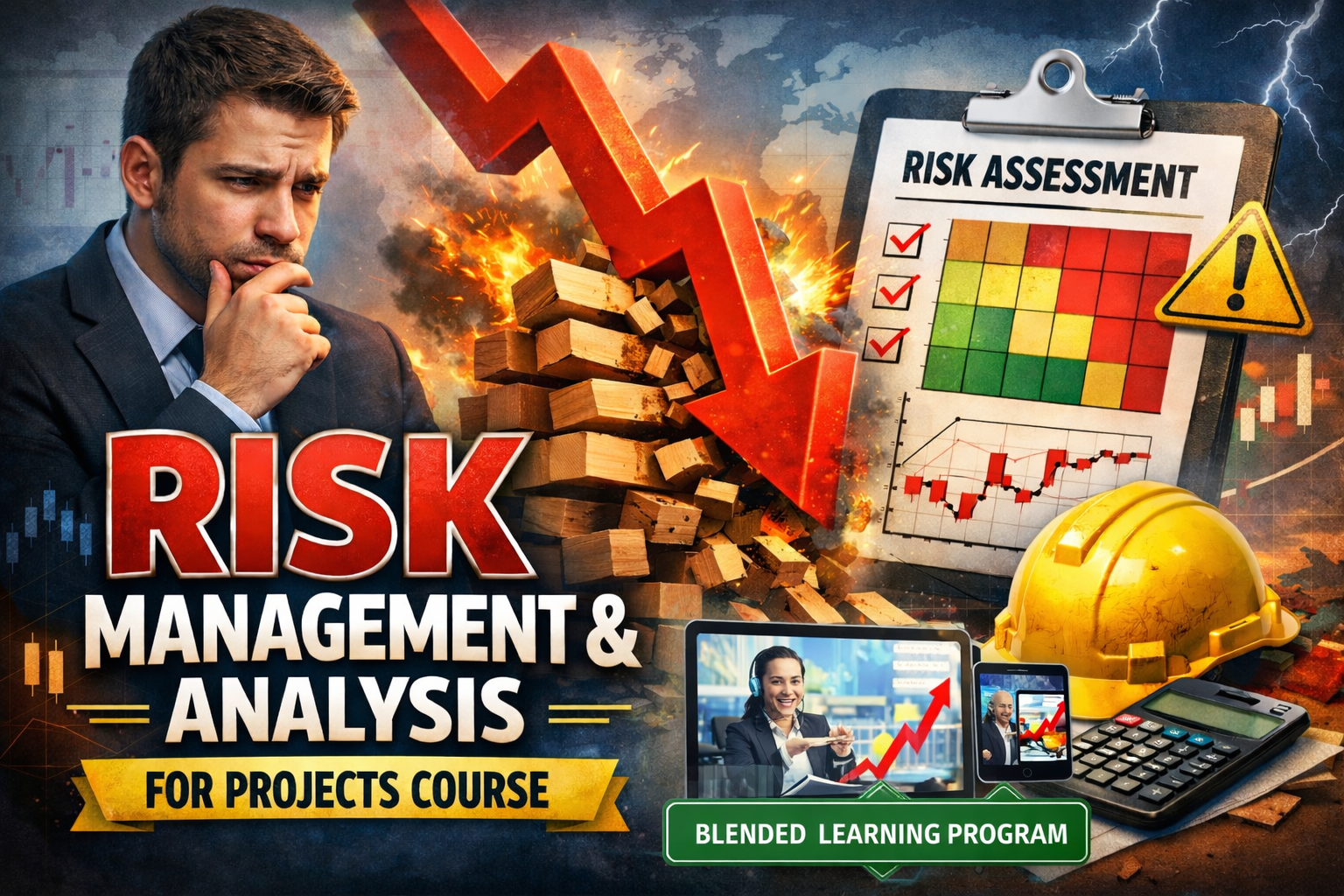
Risk Management & Analysis for Projects – Blended Learning Program
Categories: Blended courses
Wishlist Share

About Course

Risk Management & Analysis for Projects – Blended Learning Program

Understand project risks and learn how to manage uncertainties with flexible learning and expert support.

Blended Mode • 80% Self Learning + 20% Live Support

Course Overview

This program helps you understand the fundamentals of risk management at your own pace.
You will learn how to identify risks and apply basic analysis techniques with guided support.

What You Will Learn

  • Basics of project risk management
  • Types of risks in projects
  • Introduction to risk identification
  • Basic risk analysis concepts
  • Understanding risk impact
  • Simple mitigation approaches

Who This Course is For

  • Working professionals with limited time
  • Engineers new to risk management
  • Planning professionals upgrading skills
  • Anyone interested in project planning concepts

Why Choose Blended Mode

  • Flexible learning schedule
  • Access materials anytime
  • Learn at your own pace
  • Live support sessions included

Understand and Manage Project Risks

Build strong fundamentals with flexible learning

Show More

Course Content

SECTION 1 – INTRODUCTION TO PROJECT RISK MANAGEMENT
In this section, we are going to build a strong foundation for understanding risk in projects. Before we move into tools and analysis, it is very important to clearly understand what risk actually means in real construction scenarios. We will discuss how risks arise, how they affect projects, and why many projects fail not because of poor planning—but because of unmanaged risks.

  • Lesson 1.1: Understanding Risk in Projects
  • Lesson 1.2: Risk vs Issue
  • Lesson 1.3: Importance of Risk Management
  • Lesson 1.4: Risk Management Process

SECTION 2 – RISK IDENTIFICATION
In this section, we move from understanding risk to actively identifying it within real projects. Risk identification is one of the most critical stages in risk management—because you cannot manage what you have not identified. This section will train you to think like an experienced planner by recognizing hidden risks, understanding their sources, and systematically documenting them using a structured risk register. By the end of this section, you will develop the ability to “see risk before it becomes a problem.”

SECTION 3 – QUALITATIVE RISK ANALYSIS
In this section, we move from identifying risks to evaluating them in a structured and meaningful way. Not all risks deserve equal attention, and one of the most important skills of a planning engineer is the ability to prioritize risks effectively. This section introduces the concepts of probability and impact, explains how to assess risk severity, and teaches the use of risk matrices for decision-making. By the end of this section, learners will be able to distinguish between critical and non-critical risks and focus their efforts where it truly matters.

SECTION 4 – QUANTITATIVE RISK ANALYSIS
In this section, we move from qualitative judgment to quantitative analysis. Until now, we have identified and prioritized risks—but here we go deeper by measuring their impact numerically. This section introduces Monte Carlo simulation, a powerful technique used by professional planners to predict realistic project completion dates under uncertainty. Learners will understand how to model risk using three-point estimates, interpret probability curves, and make informed decisions based on confidence levels such as P50 and P80. This is a critical skill for advanced planning, forecasting, and delay analysis.

SECTION 5 – RISK RESPONSE PLANNING
In this section, we move from analysis to action. Identifying and analyzing risks is only valuable if we know how to respond to them effectively. This section teaches how to select appropriate risk response strategies based on risk severity, project constraints, and practical feasibility. Learners will understand how to reduce, eliminate, transfer, or accept risks in a structured way. The section also introduces contingency planning and the concept of risk ownership, ensuring that risks are actively managed throughout the project lifecycle.

SECTION 6 – RISK MONITORING & CONTROL
In this section, we move into continuous risk management during project execution. Risk management is not a one-time activity—it is an ongoing process that evolves with the project. This section teaches how to track risks, update their status, evaluate the effectiveness of mitigation strategies, and integrate risk management with project control systems. Learners will understand how professional planners conduct risk reviews, maintain updated risk registers, and ensure that risks are actively managed throughout the project lifecycle.

SECTION 7 – RISK MANAGEMENT IN PRIMAVERA (P6 + PRA INTEGRATION)
In this section, we connect risk management with project scheduling using Primavera tools. Risk should not exist separately from planning—it must be embedded within the project schedule. This section teaches how to identify risk-sensitive activities, apply uncertainty using three-point estimates, and prepare schedules for advanced risk analysis. Learners will understand how professional planners convert a static schedule into a risk-aware model, forming the foundation for simulation and forecasting.

SECTION 8 – RISK ANALYSIS USING SOFTWARE (PRA – ADVANCED)
In this section, we move into practical risk analysis using Primavera Risk Analysis (PRA). This is where all previous concepts come together—risk identification, uncertainty modeling, and schedule preparation. Learners will understand how to import schedules, apply uncertainty distributions, run Monte Carlo simulations, and interpret outputs such as histograms, S-curves, and tornado diagrams. This section transforms theoretical knowledge into real-world analytical capability used in project controls, forecasting, and delay analysis.

SECTION 9 – REAL PROJECT CASE STUDY (FULL IMPLEMENTATION)
n this section, we apply everything learned throughout the course to a real-world construction project scenario. This is where theory becomes practice. Learners will walk through the complete lifecycle of risk management—from identification to analysis, response planning, monitoring, and final outcome evaluation. The focus is not just on tools, but on decision-making, judgment, and practical application as used by experienced planning engineers and project controls professionals.

SECTION 10 – INTERVIEW PREPARATION & EXPERT MASTERY
This final section prepares learners to confidently apply risk management knowledge in professional environments. It focuses on interview preparation, expert-level understanding, and practical communication of concepts. Learners will be trained to answer real interview questions, explain risk concepts clearly, and demonstrate their ability to think analytically and make decisions. This section bridges technical knowledge with professional presentation, ensuring learners are ready for senior planning and project control roles.

Student Ratings & Reviews

No Review Yet
No Review Yet
Scroll to Top