
Enroll Now

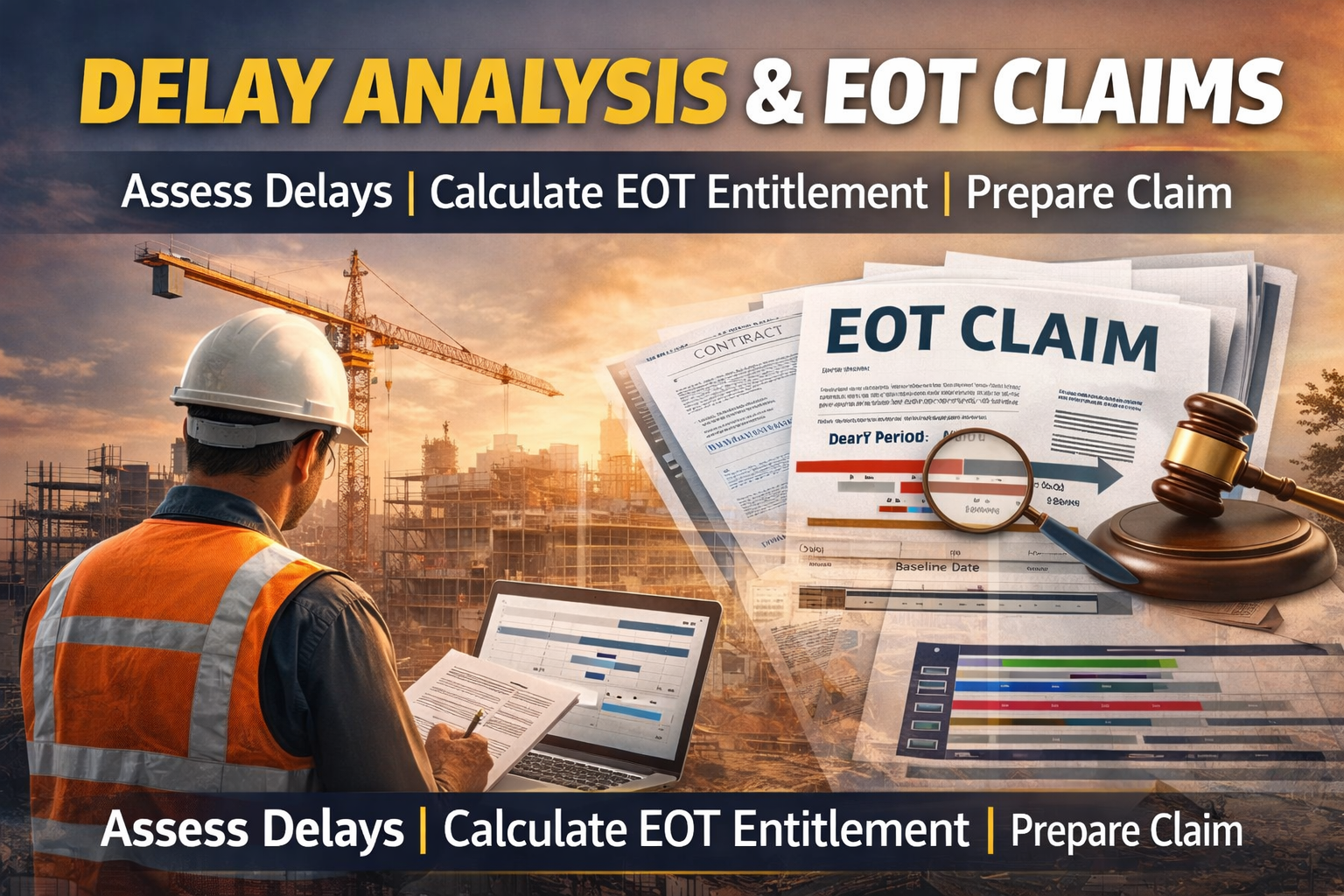
Delay Analysis and Extension of Time (EOT) Claims Training for Construction Projects
Wishlist Share

About Course

Delay Analysis & EOT – Live Interactive Training

Master delay analysis techniques and Extension of Time (EOT) claims used in real construction projects.

100% Interactive Online Training • Live Case-Based Learning

Course Overview

This advanced training program focuses on delay analysis methodologies used in real projects.
You will learn how to identify delays, analyze their impact, and prepare professional EOT claims.

What You Will Learn

  • Understand types of delays in construction projects
  • Perform critical path analysis
  • Apply delay analysis techniques
  • Prepare Extension of Time (EOT) claims
  • Interpret contract conditions (FIDIC basics)
  • Analyze project delays using real scenarios

Who This Course is For

  • Planning Engineers handling project schedules
  • Project Controls professionals
  • Quantity Surveyors and contract engineers
  • Engineers involved in claims and disputes

Why Choose Live Training

  • Real project case study discussions
  • Step-by-step delay analysis explanation
  • Live interaction and doubt clarification
  • Practical understanding of claims preparation

Upgrade to High-Value Planning Skills

Learn delay analysis and EOT from real industry experience

Show More

Course Content

SECTION 1: Foundations of Delay & EOT Claims
🎯 Section Objective Understand the legal, contractual, and planning fundamentals of delay and Extension of Time (EOT). 📘 Topics Covered What is delay in construction projects Types of delays (Critical vs Non-critical) Excusable vs Non-excusable delays Compensable vs Non-compensable delays Introduction to EOT claims Role of planner in claims 🏗 Real Project Context Delay is not just schedule slippage — it is contractual entitlement. Misclassification → claim rejection. ⚠️ Common Industry Gap Most engineers: Know Primavera But don’t understand claim logic

  • Lesson 1.1 – What is Delay in Construction Projects?
  • Lesson 1.2 – Classification of Delays
  • Lesson 1.3 – Role of Critical Path in Delay Analysis
  • Lesson 1.4 – Causes of Delays in Construction Projects
  • Lesson 1.5 – Importance of Delay Analysis

SECTION 2: Contractual Framework (FIDIC & Beyond)
🎯 Section Objective Interpret contracts for delay entitlement. 📘 Topics Covered Key clauses in FIDIC (8.4, 8.5, 20.1) Notice requirements Record keeping Concurrent delay basics Burden of proof 🏗 Real Project Context Claims fail not due to analysis—but due to: Missing notices Improper documentation

SECTION 3: Primavera P6 for Delay Analysis
🎯 Section Objective Use Primavera as a forensic tool, not just planning software. 📘 Topics Covered Baseline creation Updating schedules Critical path tracking Float analysis Progress override vs retained logic

SECTION 4: Time Impact Analysis (TIA) — Advanced
🎯 Section Objective Perform prospective delay analysis using TIA. 📘 Topics Covered Concept of fragnet Delay insertion Re-running schedule Impact quantification

SECTION 5: Windows Analysis — Advanced Forensic Method
🎯 Section Objective Perform retrospective delay analysis. 📘 Topics Covered Window segmentation As-built vs as-planned Critical path shifts Delay attribution

SECTION 6: Concurrent Delay Analysis
🎯 Section Objective Handle multiple delays scientifically. 📘 Topics Covered Types of concurrency Contractor vs Employer delays Apportionment methods

SECTION 7 — PRIMAVERA-BASED FULL DELAY ANALYSIS WORKFLOW
🎯 Section Objective This section provides a complete, practical workflow for performing delay analysis using Primavera P6. It integrates baseline management, schedule updates, delay insertion, and analytical outputs required for EOT claims

SECTION 8: EOT Claim Preparation & Submission
🎯 Section Objective Convert analysis into a winning claim document 📘 Topics Covered Report structure Narrative writing Delay justification Supporting documents

SECTION 9 — REAL CASE STUDY (FULL DETAILED + SCREENSHOTS)
This section demonstrates a real-world application of delay analysis and EOT claim preparation using a G+5 residential building project. It integrates all concepts learned in previous sections into a practical scenario.

SECTION 10 — INTERVIEW & EXPERT LEVEL MASTERCLASS
This section prepares learners for job interviews, client discussions, and consultancy roles. It includes practical questions, scenario-based thinking, and expert-level insights required for real-world applications.

Resources/Downloads

Final Examination

Student Ratings & Reviews

No Review Yet
No Review Yet
Scroll to Top